When Rubbish Becomes Possibility
The other day, I arrived at Forest School with a bundle of straw from a local farmer.
The farmer, who knows me well enough by now, was curious.
“What are you making with it this time?”
Scarecrows, I told him.
And that’s exactly what the Year 3 children set about making.
I showed them how to create the basic structure—the body, the head, the shape that would allow their scarecrow to stand.
Then I stepped back.
Because once the foundations were there, I wanted to see who these scarecrows would become.
The children searched around the woodland for feathers, catkins, leaves, sticks and anything else they felt could bring their creation to life.
There were no two alike.
And then one little girl found something that, at first glance, didn’t look like it belonged in a creative activity at all.
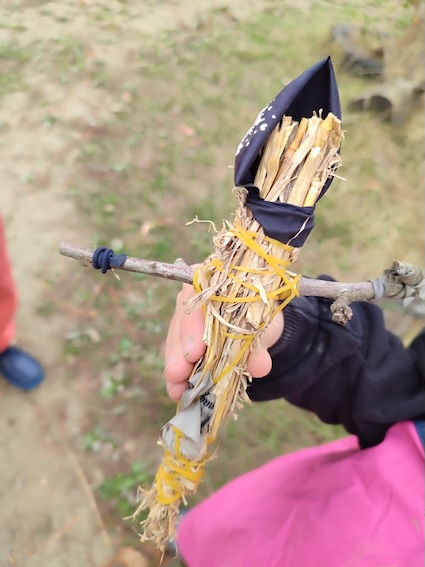
A deflated, pierced rubber balloon.
It had somehow found its way into the hedge, blown there by the wind.
She picked it up.
And then she had an idea.
Before long, that sad little piece of litter had become the coolest hooded cloak.
Suddenly, her scarecrow had a completely different character.
It was brilliant.
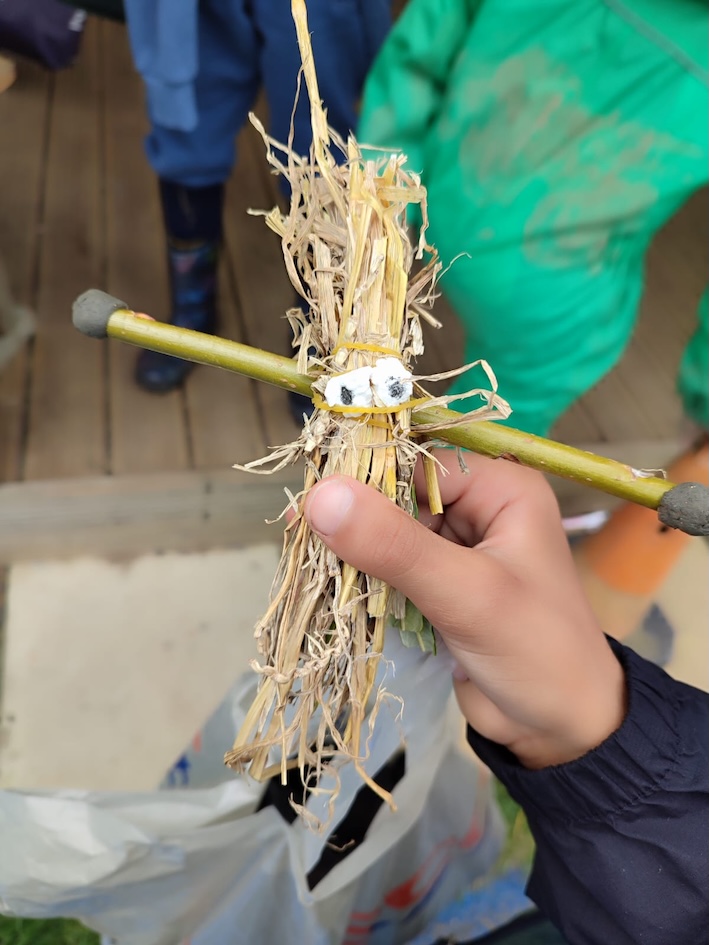
A little later, a boy came across the tiniest piece of polystyrene.
“Can I have a pen?”
He drew a pair of Minion-style eyes onto it and carefully attached them to his scarecrow.
And there it was again.
Something discarded becoming something imaginative.
Something unwanted becoming part of a creation.
That’s upcycling at its most joyful.
Litter deeply upsets me. I find it difficult to understand how something can simply be thrown away without a thought for where it might end up or what it might affect.
But watching these children interact with the pieces of litter they found in the woods gave me a different perspective.
They didn’t see rubbish.
They saw possibility.
And, importantly, they also understood that by using these objects, they were taking them out of the natural environment.
It opened up a conversation about littering, about looking after the places we love, and about the impact our choices can have on the natural world.
We talked about how artists sometimes collect discarded objects and transform them into thought-provoking pieces of art.
Perhaps that’s because there is something powerful about taking something that has been overlooked and asking:
What else could this become?
I left that session feeling unexpectedly hopeful.
Because perhaps environmental awareness doesn’t always begin with a lecture about protecting the planet.
Perhaps sometimes it begins with a child picking up a piece of rubbish and seeing possibility in it.
With curiosity.
With imagination.
With the understanding that what we leave behind matters.
Who knows?
Maybe amongst those children was a future artist who will one day create something that makes thousands of people stop and think about the world around them.
Maybe not.
But for an hour in the woods, they were already practising the kind of thinking our world needs more of.
Looking differently.
Using what is already there.
Finding beauty and possibility in unexpected places.
And leaving the woods a little better than they found them.
I’ll take that as a reason for hope.
A question to take with you…
What might you see differently if, instead of asking “What is this?”, you asked, “What could this become?”