Too Big to Play?
Every summer, I notice it.
Year 6 children ( 11 years old) arrive at Forest School carrying something different.
Some are excited about moving on. Some have mentally checked out of primary school weeks before the end of term. Many seem caught somewhere in between. They’re beginning to let go of childhood, but they’re not quite ready to leave it behind.
I often hear the same phrases.
“That’s for little kids.”
“I’m too big for this now.”
And I always wonder…
Do they really believe that?
Or do they think that’s who they’re supposed to become?
This week reminded me just how powerful that question is.
Before our session had even begun, three girls came to speak to me. There had been arguments. Hurtful words had been exchanged over the previous couple of days.
I listened.
As they talked, it became clear that underneath the unkindness was something much more familiar: the desperate need to belong.
I gently suggested that perhaps the girls who had been hurtful weren’t feeling secure in themselves. Sometimes people say things they don’t really mean because they’re trying so hard to find their place.
“That’s not an excuse,” I told them. “The behaviour still isn’t okay.”
“But I think we’ve probably all felt like we didn’t belong at some point.”
They all nodded.
Almost instantly, the conversation shifted. The hurt didn’t disappear, but it became easier to understand. It wasn’t about them being unworthy. It was about someone else struggling.
Then we began.
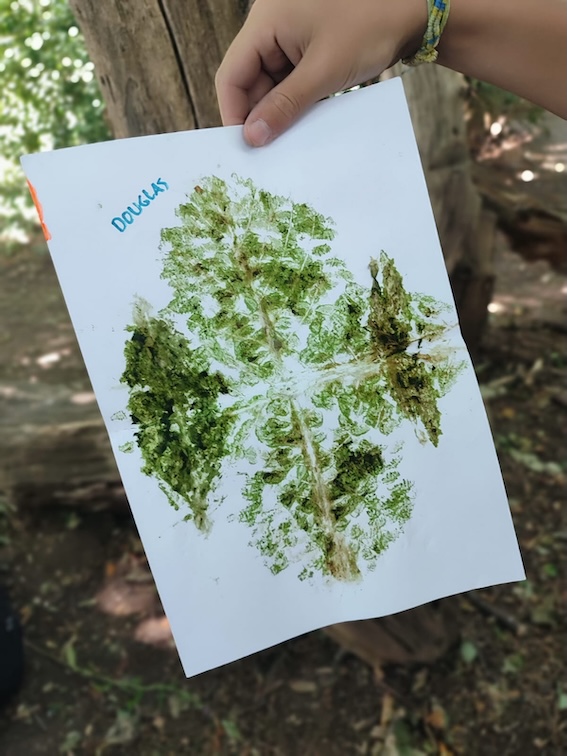
Our activity was Happazome, collecting leaves and flowers before transferring their natural pigments onto paper/fabric with hammers.
The girls I’d spoken with settled into creating straight away. The others disappeared into the forest school area.
Halfway through the session, I noticed the two girls who had been unkind sitting quietly to one side. They weren’t joining in.
I wandered over.
“It looks like you’ve had quite a hard day,” I said.
I invited them to come and have a go.
One hesitated. She used to throw herself into every Forest School activity.
The other smiled awkwardly.
“I don’t do activities anymore,” she said.
“I’m boring.”
I smiled.
“But if you can’t do this when you’re in primary school… when will you?”
She rolled her eyes a little… then smiled.
“Go on then.”
Within minutes, both girls had completely forgotten they were supposedly “too old.”
They experimented with different leaves.
They discovered which flowers made the brightest prints.
They began making their own natural paints.
Ideas bounced between them.
They laughed.
They concentrated.
They became wonderfully absorbed.
For over an hour.
The most remarkable part?
Without anyone planning it, they ended up creating alongside the very girls they’d argued with.
No forced apology.
No awkward intervention.
No reminders to be kind.
Just four children, side by side, immersed in making something beautiful.
Sometimes, when our hands are busy creating, our hearts quietly soften too.
Later, as conversations drifted naturally, I mentioned how challenging the world can sometimes feel for girls and women.
“It’s so much easier,” I said, “when we choose to support each other instead of competing.”
There was silence.
Not uncomfortable silence.
Reflective silence.
They nodded.
Then carried on hammering flowers.
Forest School often reminds me that children don’t always need adults to fix everything.
Sometimes they need a space where they can stop performing.
A space where they don’t have to prove they’re grown up.
A space where belonging happens naturally because everyone is focused on the same simple thing.
It’s easy to think that creativity is something children outgrow.
I don’t believe that.
I think many children simply learn that enjoying things isn’t always considered “cool.”
But give them permission to create without judgement…
Give them time…
Give them a little encouragement…
And suddenly they’re not trying to act like teenagers anymore.
They’re simply children again.
Perhaps that’s what Forest School offers Year 6 more than anything during these final weeks of primary school.
Not preparation for secondary school.
A gentle reminder that they don’t have to rush out of childhood before they’re ready.