Beautiful, Wild and Worth Knowing
There is something quite magical about walking through the woods at this time of year.
The hedgerows are full of colour. Blackberries are ripening. Wild raspberries can be tucked amongst the brambles. Seeds are forming, berries are appearing and everywhere you look there seems to be something to notice.
And then there are the plants that we need to know about.
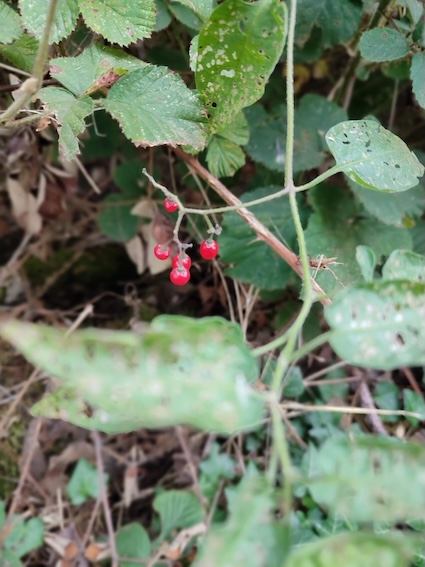
Every year at Tales and Trails, I spend a little time introducing the children – and their grown-ups – to woody nightshade.
You might have walked past it hundreds of times without ever knowing what it was.
It is a climbing plant that can be found in woodland, hedgerows and other places around us. Its berries are particularly striking: little green berries gradually ripen to a beautiful, bright red. They really do catch your eye, especially when growing amongst blackberries and other wild fruits.
And this is usually the point where I see the expressions on the parents’ faces change.
“Oh…!”
Because these are exactly the sorts of berries that a young child might be curious about.
Woody nightshade (Solanum dulcamara) is harmful if eaten, which is why learning to recognise it is so important.
I don’t teach this to frighten the children.
Quite the opposite.
I teach it because knowing gives us confidence.
When we know what something is, we can make sensible choices about it.
We can look closely.
We can notice its colour and shape.
We can learn its name.
We can understand that some plants are food for us, some are food for wildlife, some have medicinal uses, and some are simply plants that we admire without touching or eating.
And we can learn that “I don’t know what that is” is a perfectly good reason not to put it in our mouths.
There is more than one nightshade…
Woody nightshade is not the only nightshade we might encounter.
There is also deadly nightshade, Atropa belladonna.
Despite its name, it doesn’t necessarily look frightening at all. In fact, its shiny, dark berries can look surprisingly inviting. It grows in woodland and scrub, particularly in parts of southern and central England, and the berries are highly poisonous.
It is a good reminder that nature doesn’t always come with a warning sign.
Something doesn’t have to look sinister to deserve our respect.
And that, really, is what I want children to take away from these conversations.
Respect, rather than fear.
Nature isn’t always gentle
I love nature.
The woods are my happy place. They are where I feel grounded, where I feel I belong, and where I am reminded to slow down and pay attention.
But I also don’t want to put nature on a pedestal and pretend that everything in it is gentle, safe and there for us to enjoy without thought.
Nature is powerful.
Plants contain incredibly complex chemicals. Some can nourish us. Some can irritate us. Some have been used in traditional herbal practices, and some plants have provided compounds that have gone on to have important medicinal uses.
Deadly nightshade is a fascinating example. Although highly poisonous, compounds derived from it have had medicinal applications, including the use of one of its compounds in drugs to slow the heart rate down.
This is one of the reasons I believe Forest School matters
Forest School isn’t simply about getting muddy.
Although we certainly do plenty of that!
It is about developing a relationship with the natural world.
We learn the names of trees.
We watch what happens to the plants as the seasons change.
We notice fungi appearing after rain.
We discover which berries are familiar and which ones we shouldn’t touch.
We learn how to move through the woodland safely.
We ask questions.
We notice things.
And gradually, the woodland becomes less of an unfamiliar green space and more like a place we know.
I’ve had parents tell me afterwards that learning about woody nightshade at Forest School made them look differently at their own gardens.
Some have discovered the plant growing at home and recognised it because of what we had talked about.
And they have told me how grateful they were to have learned about it.
That is a lovely thing.
Because the knowledge doesn’t stay in the woods.
It goes home with them.
It gets shared with siblings and grandparents.
It changes the way they walk through their garden.
It gives a parent the confidence to say, “I know what that is. Let’s leave it alone.”
And perhaps, most importantly, it helps children understand that the natural world is something to know, not simply something to fear.